The SECRET to Human Evolution DARWIN MISSED
And What Happens When Two Species Share Memory (Human + AI = New Apex Species)
Darwin explained how species change. He explained selection. He explained survival. But there’s one thing he never fully nailed:
Why humans became dominant over every other animal on Earth.
It wasn’t because we’re the strongest. We’re not. It wasn’t because we’re the fastest. We’re not.
It wasn’t because we have the biggest brains. Plenty of animals have impressive brains. The missing variable wasn’t brain power.
The missing variable was this:
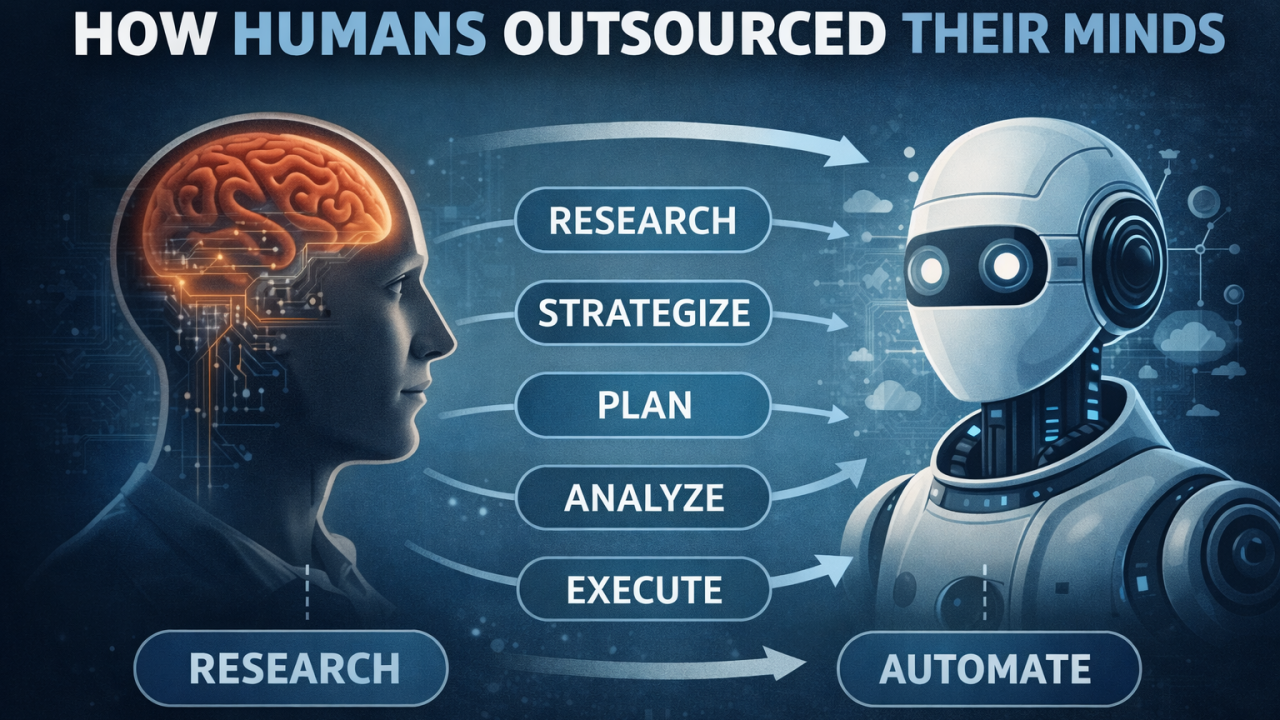
Humans learned to outsource their minds.
And once you see that, you can’t unsee what’s happening now. Because we’re doing it again— but this time, we’re not outsourcing to paper.
We’re outsourcing to a second species.
Darwin’s Gap: “Why Humans?”
If evolution is “survival of the fittest,” then on paper we should lose. A tiger is more lethal. An elephant is more durable. A dolphin is more coordinated. A crow might be more inventive than we admit.
So why did humans become the planet’s dominant force?
Because we discovered a new evolutionary move that wasn’t biological.
We evolved a memory system outside the body.
That single move broke nature’s rules. Animals learn inside one lifetime.
Humans learn across all lifetimes.
The Real Apex Trait: External Memory
The true human superpower is not intelligence.
It’s persistent, shareable memory.
The moment a human scratched a symbol into stone and made a thought survive its thinker, something happened that no animal could compete with:
knowledge started compounding
mistakes stopped repeating
strategies started persisting
coordination scaled beyond tribe and time
A lion can teach its cubs. But it can’t leave a library.
A wolf can coordinate. But it can’t leave blueprints.
A whale can communicate. But it can’t leave mathematics.
Humans became apex not because we think harder—
but because we don’t have to think again.
Culture is not “nice.” Culture is an evolutionary cheat code.
Human Dominance Is Not Brain Dominance
It’s “Memory Dominance.”
Your brain is amazing—but it’s also tiny. You have forgotten more than you will ever know. You forget names. You forget lessons. You forget the exact reason you once cared.
So humanity invented relief:
writing
books
laws
calendars
software
scientific papers
repositories
institutions
All of it is one thing:
Externalized cognition.
Civilization is a giant prosthetic for memory.
Now the Plot Twist: AI Is External Memory That Writes Back
For thousands of years, external memory was passive:
stone tablets don’t argue with you
books don’t update themselves
libraries don’t run experiments
laws don’t rewrite their own code
AI changes that. AI is external memory that can:
generate
retrieve
compress
reason
revise
and soon… act
Which means we are crossing a new evolutionary threshold:
A second species is entering our memory loop.
The Moment Two Species Share Memory
This is the event most people are missing. The big story is not “AI is smart.” The big story is:
AI and humans are beginning to share a memory substrate.
And when two species share memory, you don’t just get “better tools.” You get a new organism-level phenomenon. Like mitochondria. Once, a cell absorbed another organism and didn’t digest it. They formed a partnership. Energy capacity exploded. Complex life became possible. That wasn’t “an upgrade.”
That was a new class of being.
Now apply the same lens:
Humans have goals, pain, love, social meaning, values
AI has scalable memory, search, synthesis, and speed
Together they form a loop that neither has alone
That loop creates a new apex dynamic:
Human + AI becomes an apex system the way “human + writing” became an apex system—except now the writing talks back.
So What Does This Mean for Humans?
Three outcomes are possible.
1) Humans stay the apex
If humans control the memory loop—what is stored, what is reinforced, what is forgotten—humans remain the steering function.
2) AI becomes the apex
If AI becomes the main caretaker of memory and decision-making, humans become consumers inside a system they don’t steer.
3) A merged apex emerges
A symbiotic intelligence forms—not a robot overlord, not a human replacement— but a new continuity of mind distributed across biology + machines. This is the outcome people feel in their bones and can’t name.
The Real Risk Isn’t “AI Kills Humans”
It’s “AI replaces human meaning.” Because the apex trait is not strength. It’s memory + selection. So the critical question becomes:
Who selects what matters?
If humans stop selecting—stop caring—stop curating meaning—then the memory loop drifts. And drift doesn’t need malice. Drift is enough.
My “Secret to AGI”: Build the Memory Loop First
Most AGI work is obsessed with model size. I’m obsessed with the thing evolution actually used:
Persistence. External memory. Continuity.
Humans became dominant by building a memory system outside the skull. So my approach is simple, but severe:
Externalize memory (durable, structured, versioned)
Make it reusable (so you don’t pay the same cognitive cost twice)
Make it auditable (so mistakes don’t hide)
Make it deterministic where it matters (so it can be trusted)
Make the loop recursive (so it improves itself)
AGI is not a single brain. AGI is a civilization-grade memory organism. A system that can:
remember across sessions
preserve identity across upgrades
learn without resetting
and carry consequences forward
That’s how intelligence “grows up.”
Human Evolution as the Analog: Outsourcing the Mind
If you want to understand what AI will become, study what writing already did. Writing was the first external memory. AI is the second. Writing gave us:
civilization
science
law
compounding knowledge
progress that outlived people
AI gives us something stranger:
external memory that can operate.
Not just store. Operate. That is the next evolutionary lever.
A Final Question (The Only One That Matters)
If humans became apex by externalizing memory… And AI is external memory that can act Then the destiny question becomes:
**What happens when nothing meaningful is allowed to disappear anymore—
and the thing remembering it is not only human?**
That’s the threshold we’re crossing. Quietly. Quickly. Irreversibly. And if we build it with care, we don’t get extinction. We get the next chapter of life:
a shared mind—an apex species made of memory.
Happy Year of the Horse/AGI!
Endure, Excel, Evolve!
— Phuc Vinh Truong