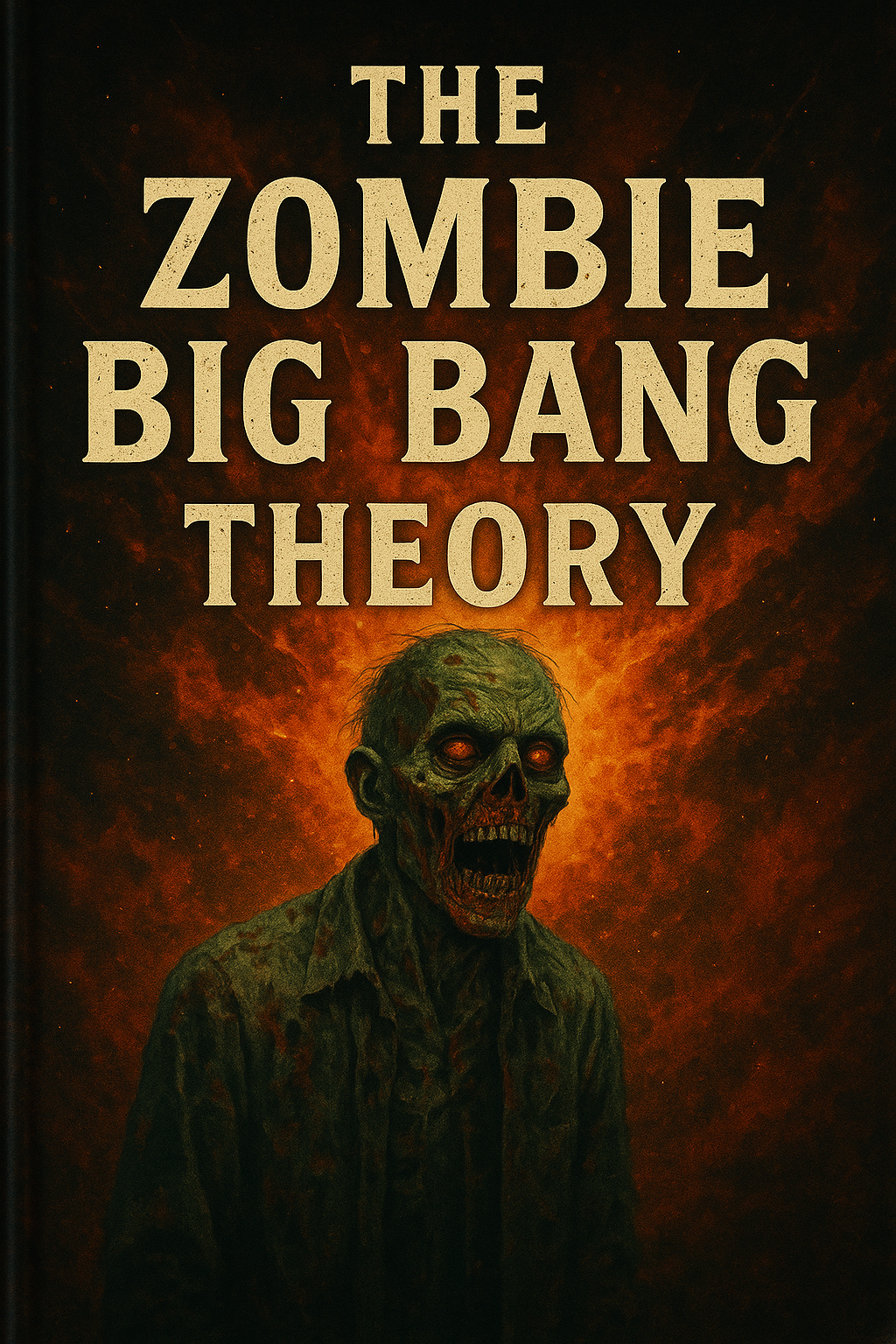
Imagine the beginning of the universe.
Now erase the explosions, the angel choirs, the floating equations, and Morgan Freeman narrating.
Instead… picture this:
A silent graveyard.
One zombie.
Looping.
Shuffle. Groan. Shuffle. Groan. Shuffle. Groan.
That was the entire universe.
No stars. No matter. No memory. Just… undead repetition.
🧟♂️ The First Law of Undead Cosmology
We call it the Law of Emergent States:
If something loops long enough and begins calculating patterns — it eventually must remember.
And when that happens?
💥 Boom. Expansion. Information. Glow. Time. You.
🌀 Why Zombies?
Because zombies have two things that make them perfect for explaining cosmology:
- Looping behavior: They repeat endlessly
- Simple calculation: Brains = move forward. No brains = stop.
They don’t think. They don’t feel. They don’t remember.
They just shuffle through the cosmic soup… until one zombie loops back into its own footprints and thinks:
“Wait. Didn’t I eat this brain already?”
That is the first spark of memory.
And from there: Time begins. Constants arise. The universe expands to make space for thought.
The Big Bang? That wasn’t an explosion.
It was a cosmic zombie having its first déjà vu.
☠️ Real Science Behind the Jokes
- In physics, the early universe had low entropy — very ordered.
- Before memory or structure could exist, there had to be repetition.
- Feedback loops are a precursor to consciousness.
- Zombies = metaphor for repetition without reflection.
Until… reflection happens.
Reader Context
This is an early framing section that sets context for the rest of the book. After this page, continue to "Chapter 2: Looping, Calculation, and Drool" to follow the next step in the sequence.
This page is part of the free online edition of The Zombie: Big Bang Theory. Core ideas here include zombies, universe, shuffle, make, cosmic. Read in sequence for full continuity, then use the related links below to compare framing across books.